 Written and reviewed by Dr. Vaishnavi Karmawat, B.V.Sc. & A.H., Registered Veterinary Practitioner
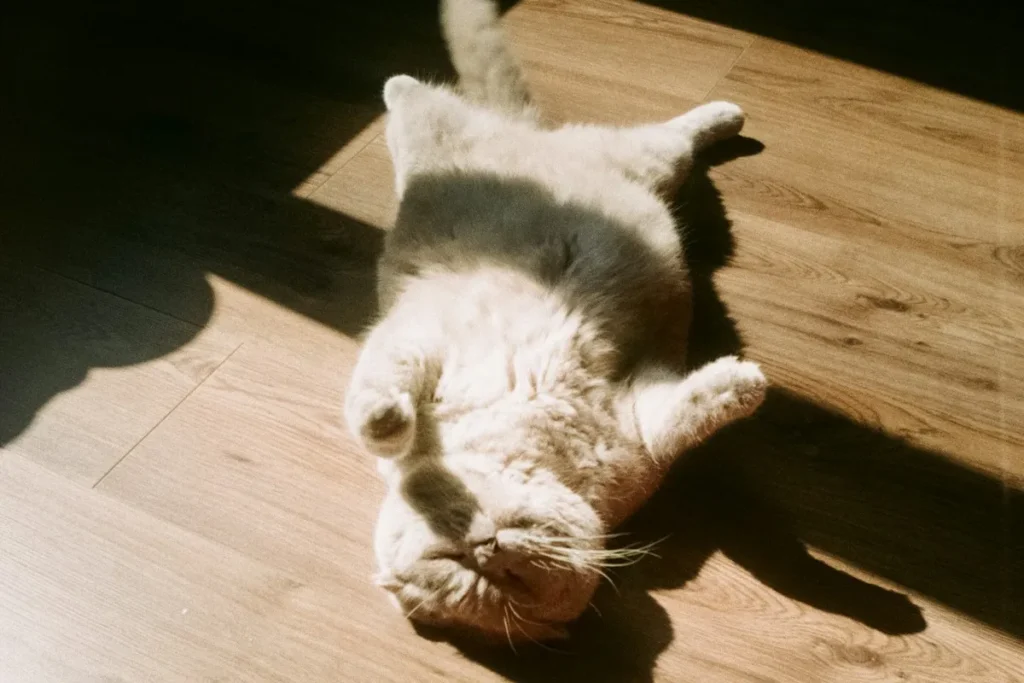
If your young female cat suddenly starts yowling loudly at night, rolling on the floor, rubbing against everything and trying to escape through every open door, she is almost certainly in heat. Many first-time owners rush to the vet thinking their cat is in pain. She is not, but the behaviour is exhausting for everyone, and it repeats every few weeks until she is mated or spayed.
In this article
Here is when cats go into heat, how long it lasts, the signs, how to keep her calm and safe, why hormone injections are risky, and why spaying, even during heat, is the best solution.
Key Takeaways
- Most female cats have their first heat between 5 and 9 months of age, but some start as early as 4 months.
- Each heat (oestrus) usually lasts about a week (3 to 14 days) and can return every 1 to 3 weeks if she does not mate.
- In India’s warm climate with long daylight hours, many cats cycle for most of the year.
- Cats in heat do not bleed. Signs are behavioural: loud yowling, rolling, extra affection, raised hindquarters, restlessness and sometimes urine marking.
- Cats ovulate only after mating, so a cat can become pregnant from a single escape.
- Spaying is the only reliable, safe way to stop heat. It can be done during heat, and spaying before the first heat greatly lowers the risk of mammary cancer.
- Avoid hormone injections or tablets to suppress heat; they can cause diabetes, uterine infection and mammary tumours.
When Do Cats Go Into Heat?
Female cats (queens) reach puberty between about 5 and 9 months, depending on breed, body weight and season. Oriental breeds such as Siamese can start earlier, and heavier long-haired breeds such as Persians later. Some kittens cycle as early as 3 to 4 months, which is why kittens should be spayed in good time.
Cats are seasonally polyoestrous and long-day breeders: increasing daylight triggers their cycles. In temperate countries, cats rest in winter. In India, with long days for much of the year, many cats, especially those exposed to natural light, cycle almost year-round, with peaks in spring and summer.
How Long Is a Cat in Heat? The Four Stages
| Stage | Length | What happens |
|---|---|---|
| Proestrus | 1–2 days | Oestrogen rises; males show interest, but she is not yet receptive. Signs are subtle. |
| Oestrus (heat) | Usually about 7 days (3–14) | She is receptive to mating; loud calling, rolling, mating posture |
| Interoestrus | About 1–3 weeks | If she does not mate or ovulate, hormones fall briefly before the next heat |
| Metoestrus / pregnancy | About 30–40 days, or 63–65 days if pregnant | If she mates and ovulates, she either becomes pregnant or has a false pregnancy |
| Anoestrus | Weeks to months | Reproductive rest, usually during shorter days |
Why cats cycle so often
Cats are induced ovulators. Unlike dogs and people, they do not release eggs on a fixed schedule; the act of mating stimulates the release. An unmated cat therefore does not complete her cycle, and returns to heat again and again, sometimes with only a week’s break. This is why an unspayed indoor cat can seem to be “always in heat”.
Signs of a Cat in Heat

- Loud, persistent yowling or calling (caterwauling), often at night, to attract males. Owners often mistake it for pain.
- Extra affection: rubbing her head and body on people, furniture and doorways
- Rolling on the floor and wriggling
- Lordosis (mating posture): front end down, hindquarters raised, tail held to one side, and treading with the back feet, especially when stroked along the back
- Restlessness and trying to get outside, sometimes desperately
- Reduced appetite
- Urine marking or peeing outside the box in some cats. See cat peeing outside the litter box.
- Male cats gathering outside your home and spraying near doors and windows
Cats in heat do not normally have visible bleeding. A small amount of clear discharge can occur, but any bloody or pus-like vaginal discharge is not normal and needs a vet urgently.
What To Do if Your Cat Is in Heat
Keep her safely indoors
- Close windows, balcony doors and grills, and check for gaps. Cats in heat are skilled escape artists, and one escape can mean a litter of kittens.
- Keep unneutered male cats away from her, including male cats in the same home.
- If she must travel, use a secure, closed carrier.
Help her feel calmer
- Offer extra play with wand toys and puzzle feeders to use up energy.
- Give her a warm, quiet resting place; some cats settle on a warm (not hot) towel or heat pad set on low.
- Gentle brushing and attention help many cats.
- Block the view of outdoor cats and clean any spots where tomcats have sprayed nearby.
- Calming pheromone diffusers may help some cats.
- Do not punish or isolate her. The behaviour is hormonal and not under her control.
Avoid hormone injections and pills to stop heat
Progestogen injections and tablets (such as medroxyprogesterone or megestrol) are sometimes sold or given in India to “stop heat”. In cats they are linked to serious side effects, including diabetes, life-threatening uterine infection (pyometra), mammary gland enlargement and mammary tumours, and adrenal suppression. Human contraceptive pills must never be given. For pet cats, spaying is far safer.
Can You Spay a Cat in Heat?
Yes. Vets routinely spay cats in heat. During heat the uterus and its blood vessels are larger and more fragile, so surgery may take a little longer and carries a slightly higher risk of bleeding, and some clinics charge a little more. However, waiting for the heat to end can be risky, because in a cat that cycles every couple of weeks there may be no safe gap, and every week of waiting is another chance of escape and pregnancy. Your vet will advise on timing.
Benefits of Spaying Your Cat

- No heat cycles: no yowling, rolling or escape attempts, and a calmer household
- No unwanted kittens: important in India, where many kittens are abandoned or die on the streets
- No pyometra: a life-threatening uterine infection seen in unspayed cats
- Much lower risk of mammary cancer: in cats, mammary tumours are usually malignant. Research found that cats spayed before 6 months of age had about a 91 percent lower risk, and those spayed before 1 year about an 86 percent lower risk, compared with unspayed cats. The protective effect drops sharply after two years.
- No ovarian or uterine disease and no false pregnancy
- Less urine marking and less roaming
When should I spay my cat?
Most vets recommend spaying at around 5 to 6 months of age, before the first heat. Earlier spaying (from about 8 to 12 weeks, at an appropriate weight) is safe and used by many shelters and animal birth control programmes. There is no health benefit in letting a cat have one heat or one litter first.
Spaying myths
| Myth | Fact |
|---|---|
| A cat should have one litter first. | No medical or behavioural benefit; it increases mammary cancer risk. |
| Spaying makes cats fat and lazy. | Spaying lowers calorie needs. Adjust portions and keep her active, and she will stay slim. |
| Spaying changes her personality. | She stays the same cat, minus the hormonal heat behaviour. |
| Indoor cats don’t need spaying. | Indoor cats still cycle and are still at risk of pyometra and mammary cancer. |
What About Male Cats?
Male cats do not go into heat, but unneutered (intact) males are attracted to females in heat, roam, fight, spray strong-smelling urine and are more likely to be injured or catch FIV through bites. Neutering males at around 5 to 6 months reduces these behaviours.
Pregnancy in Cats
If your cat escaped while in heat, she may be pregnant. Cat pregnancy lasts about 63 to 65 days. Early signs include pink, enlarged nipples (“pinking up”) about three weeks after mating, weight gain and increased appetite. Your vet can confirm pregnancy with ultrasound from about three weeks or by feeling the abdomen. Feed a pregnant cat a complete kitten food and see your vet for advice. Read our kitten care guide for caring for newborns.
When To Call the Vet
- Bloody, brown or pus-like discharge from the vulva
- Lethargy, vomiting, increased thirst or a swollen belly in an unspayed cat, especially a few weeks after heat (possible pyometra)
- Heat that seems continuous for many weeks
- Your cat seems in real pain, will not eat for more than a day, or strains to urinate
Frequently Asked Questions
Do cats bleed when in heat?
No. Any bleeding from the vulva should be checked by a vet straight away.
How long does a cat stay in heat?
Usually about a week, but anywhere from 3 to 14 days, repeating every 1 to 3 weeks if she does not mate.
Why does my cat yowl at night when in heat?
She is calling to male cats. The sound is loud and can sound distressed, but it is normal heat behaviour.
Can I give my cat an injection to stop her heat?
Hormone injections can suppress heat but carry serious risks in cats, including diabetes, uterine infection and mammary tumours. Spaying is safer.
Can a 4-month-old kitten go into heat?
Yes, some do. Talk to your vet about spaying early.
This article is for education and does not replace veterinary advice.
Related Articles
- Why Do Cats Purr and Knead (“Make Biscuits”)? 5 Meanings, Including Stress and Pain
- Cat Flu (Sneezing, Runny Eyes) in Cats: Herpesvirus vs Calicivirus, Carrier Cats, Treatment and Home Care
- Cat Parvo (Panleukopenia), FeLV and FIV in India: Symptoms, Testing and Vaccines
- Why Is My Cat Vomiting? Hairballs, Yellow Bile, Worms and When To Worry
References
- Lovejoy J. Cats in Heat: How Long It Lasts and What To Do. PetMD, 2026.
- PetMD. Can You Spay a Cat in Heat?
- Overley B, Shofer FS, Goldschmidt MH, Sherer D, Sorenmo KU. Association between ovariohysterectomy and feline mammary carcinoma. Journal of Veterinary Internal Medicine, 2005;19(4):560–563.
- Romagnoli S. Progestins to control feline reproduction: historical abuse of high doses and potentially safe use of low doses. Journal of Feline Medicine and Surgery, 2015;17(9):743–752.
- Feline Fix by Five Months initiative and AAFP position statement on early-age spay/neuter.
- Little S. The Cat: Clinical Medicine and Management. Elsevier Saunders, 2012.
More on Cats

Dog and Cat Spay/Neuter Guide: Right Age, Laparoscopic vs Traditional Spay, 10-Day Stitch Care and Cone Rules
When to spay or neuter dogs and cats, open vs laparoscopic surgery, a day-by-day recovery plan, cone rules and warning signs at…

Are Essential Oils, Nilgiri Oil, Camphor, Dettol and Phenyl Safe for Dogs and Cats? Toxic Oils and Signs of Allergic Reactions
Which essential oils and household products like camphor, Dettol and phenyl are toxic to dogs and cats, poisoning signs, and safe cleaning…