 Written and reviewed by Dr. Vaishnavi Karmawat, B.V.Sc. & A.H., Registered Veterinary Practitioner
Dogs explore the world with their mouths, and some swallow things that should never go inside them: socks, handkerchiefs, toy parts, cooked bones, corn cobs, stones, hair ties, string and, in India, mango stones (guthli) in season. Many small items pass through within a day or two. Others get stuck and cause a gastrointestinal foreign body obstruction, which can cut off blood supply to the gut, make it burst and cause fatal peritonitis. This guide explains where objects get stuck, the warning signs, why you should not make your dog vomit at home without advice, how vets find and remove objects, and how to prevent it.
In this article
Key Takeaways
- Many small swallowed items pass within a day or two, but socks, bones, mango stones, string and toys can block the gut.
- A blockage can cut off blood supply to the intestine and cause fatal peritonitis.
- Call a vet now for batteries, magnets, sharp objects, string, medicines, chemicals or large items.
- Repeated vomiting, retching, drooling, a painful belly or not eating are warning signs.
- Do not make your dog vomit at home without a vet’s advice.
Call a vet now if your dog has swallowed a battery, magnet, sharp object (needle, skewer, cooked bone), string or thread, a medicine or a chemical, or a large item such as a sock or mango stone, or if your dog is vomiting repeatedly, retching, drooling, has a painful belly or is not eating.
Where swallowed objects get stuck
| Site | Typical objects | Typical signs |
|---|---|---|
| Throat (pharynx) | Balls, bone pieces, sticks | Gagging, pawing at the mouth, choking, distress |
| Food pipe (oesophagus) | Bones, rawhide chews, fish hooks | Drooling, regurgitation, repeated swallowing, refusing food |
| Stomach | Socks, stones, toys, hair ties, coins | Vomiting on and off, poor appetite; some dogs show few signs for days or weeks |
| Small intestine | Socks, corn cobs, mango stones, fruit pits, toy parts, string | Repeated vomiting, belly pain, dullness, no stools or small diarrhoea, dehydration |
| Colon and rectum | Bone fragments, hair, small hard items | Straining, constipation, blood on stools |
The pylorus (the narrow exit of the stomach) and the narrow parts of the small intestine are the most common places for objects to lodge.
Why some swallowed objects are so dangerous
- Complete blockage stops food and fluid moving. The gut above the blockage swells, the dog vomits repeatedly and loses water and salts.
- Pressure on the gut wall reduces its blood supply. If the wall dies, it can tear, leaking gut contents into the belly (septic peritonitis), which is life-threatening.
- Linear foreign bodies such as string, thread, ribbon, dental floss, tinsel or fabric strips are especially dangerous. One end anchors (often under the tongue or in the stomach) while the gut keeps moving along the rest, bunching up like a drawstring curtain. The string can saw through the intestine in several places.
- Batteries can burn the lining of the food pipe and stomach within hours. Magnets, if more than one is swallowed, can attract each other through gut walls and cause holes.
- Cooked bones splinter into sharp pieces that can puncture the gut or get wedged across the food pipe.
- Toxic objects: zinc coins, lead items, cigarettes, nicotine gum and some medicines are poisonous as well as obstructive.
Signs of a blockage
- Vomiting, especially repeated vomiting or vomiting after every meal or drink
- Retching, drooling or repeated swallowing
- Not eating, or eating then vomiting
- Belly pain: hunched back, reluctance to lie down, a “praying” position, crying when picked up
- Dullness and weakness
- Few or no stools, straining, or small amounts of diarrhoea
- Signs of dehydration
- With a partial blockage, signs can come and go for days or weeks
A dog can also seem completely normal in the first hours after swallowing something, so do not wait for symptoms if you saw it happen.
What to do right away
- Keep calm and prevent more swallowing. Remove other items and keep your dog quiet.
- Call your vet. Tell them exactly what was swallowed, how big it was, when it happened and your dog’s weight. Bring the packaging or a similar item.
- Do not make your dog vomit unless a vet tells you to. Vomiting can be dangerous for sharp items, batteries, bones, large objects that might stick in the food pipe, caustic chemicals and in dogs that are already drowsy. Home remedies such as salt water and mustard can cause dangerous salt poisoning, and hydrogen peroxide can damage the stomach lining.
- Do not pull string or thread hanging from the mouth or bottom. It may be attached to a needle or anchored deep inside.
- Do not give bread, oil, ghee, banana or laxatives to “push it through” without veterinary advice.
- If your dog is choking (struggling to breathe, blue gums), carefully look in the mouth and remove an object only if you can see and safely grasp it. For a dog that collapses, a vet-taught Heimlich technique may be needed. Go straight to the nearest clinic.
How vets diagnose a swallowed object
- History and examination, including the mouth (under the tongue for string), belly palpation, hydration and rectal exam.
- X-rays: show metal, stones, bones and many fruit stones directly. Fabric, plastic and rubber are often invisible, but the vet looks for an abnormal gas pattern of dilated gut loops. Several views may be needed, sometimes repeated a few hours later to see if the object has moved.
- Contrast X-rays in some cases, to show a blockage.
- Abdominal ultrasound: finds many objects that do not show on X-rays, and shows bunching of the gut with string or intussusception.
- Blood tests to check dehydration, electrolytes and organ function before anaesthesia.
- Endoscopy to look into the food pipe and stomach, and often to remove the object at the same time.
Treatment options
Induced vomiting (only at the clinic)
If a soft, smooth, non-toxic object was swallowed within the last one to two hours and is still in the stomach, the vet may give an injection to make your dog vomit. This is done only when it is judged safe.
Endoscopic removal
A flexible camera passed through the mouth under anaesthesia can grasp and pull out many objects from the food pipe and stomach, avoiding surgery. Success depends on the object’s size, shape and how long it has been there.
Surgery
- Gastrotomy: opening the stomach to remove an object.
- Enterotomy: opening the intestine at the site of the blockage.
- Intestinal resection and anastomosis: removing a damaged piece of intestine and joining the healthy ends.
- For linear foreign bodies, several incisions may be needed.
Recovery
Most dogs stay in hospital for 1 to 3 days for IV fluids, pain relief, anti-nausea medicines and gradual reintroduction of water and small, soft, low-fat meals. The most serious complication is leakage at the intestinal repair site, usually in the first 3 to 5 days, which shows up as vomiting, belly pain, fever or dullness. At home, follow your vet’s feeding plan, give all medicines, prevent licking of the wound and keep activity gentle for 10 to 14 days.
Outlook is good when the object is removed before the gut is badly damaged. It is poorer when there is perforation and peritonitis, when a large piece of intestine had to be removed, or when treatment was delayed.
Mango stones (guthli): a special Indian risk
Every summer Indian vets remove mango stones from dogs’ intestines. A mango stone is hard, slippery and the right size to block the small intestine of most dogs. It does not soften or digest. If your dog swallowed a whole mango stone, call your vet even if your dog seems fine. See also can dogs eat mango.
Prevention
- Pick up socks, underwear, handkerchiefs, hair ties, rubber bands, string and sewing kits.
- Never give cooked bones, chicken bones or fish bones. See can dogs eat chicken.
- Throw mango stones, corn cobs, peach and plum stones into a closed bin.
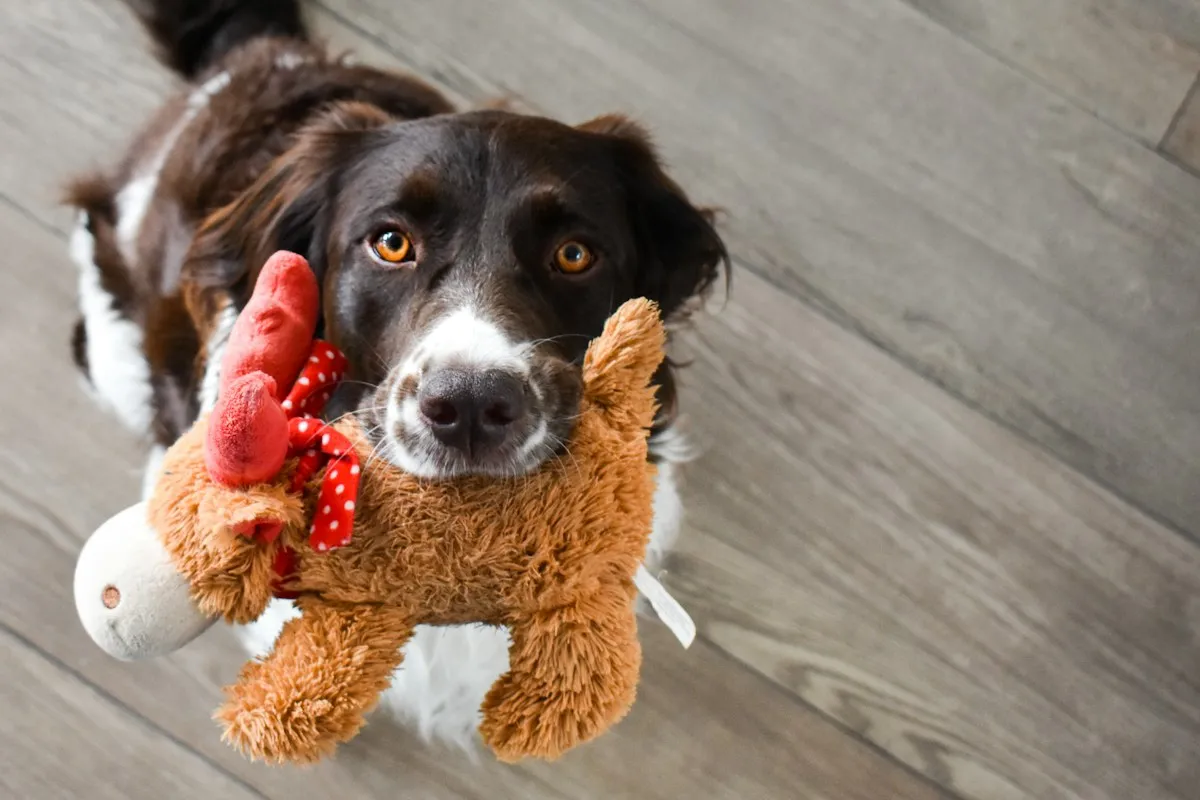
- Choose toys that are larger than your dog’s mouth and cannot be chewed into small pieces. Remove toys once they start breaking.
- Take away chews before they become small enough to swallow whole.
- Secure dustbins and keep medicines, batteries, magnets and coins out of reach.
- Puppies and young Labradors, Beagles and other enthusiastic chewers need extra supervision. Use a crate or baby gate when you cannot watch them.
- Teach “leave it” and “drop it” with rewards.
- Use a basket muzzle on walks for dogs that repeatedly scavenge, after training them to accept it.
- Dogs that eat non-food items often may have pica; see why dogs eat grass, mud and wall plaster.
🩺 Dr. Vaishnavi’s Clinical Picks (Available on Amazon India)
Safer, larger toys and chews that are hard to swallow.
Tough rubber toy that keeps dogs busy and is too big to swallow
Spread curd or mashed fruit on it; licking is calming
As an Amazon Associate, I earn from qualifying purchases. This costs you nothing extra.
Frequently asked questions
How long does it take for a swallowed object to pass?
Small, smooth items often pass in the stool within 10 to 48 hours, but some sit in the stomach for days or weeks before causing problems. Never assume something will pass without asking your vet, especially socks, mango stones, bones and string.
Should I give bread or oil to help the object pass?
No, not without veterinary advice. Bread or oil does not reliably protect the gut, and they can delay proper treatment or cause vomiting and pancreatitis.
My dog swallowed a sock but seems fine. What should I do?
Call your vet now. A sock often blocks the intestine a day or two later. If it was swallowed recently, the vet may be able to make your dog vomit it up safely in the clinic, avoiding surgery.
Can dogs pass a mango stone?
Rarely. Mango stones are large and hard and often block the small intestine. See a vet straight away.
Is it safe to pull a string from my dog’s mouth or bottom?
No. The string may be wrapped around the tongue base, attached to a needle, or spread through the intestines. Pulling can tear the gut. Cut nothing and go to a vet.
What does a blockage cost to treat in India?
Costs vary widely by city and clinic. Endoscopic removal is usually cheaper than surgery, and surgery with intestinal resection and several days of hospital care costs more. Acting early, before the gut is damaged, usually lowers both risk and cost.
Recommended reading
- The Ultimate Dog Owner’s Handbook by Dr. Vaishnavi Karmawat (Kindle eBook on Amazon)
- Puppy Training for Beginners by Dr. Vaishnavi Karmawat (Kindle eBook on Amazon)
- See all titles on the Books page.
Related Articles
- Can I Give My Dog Paracetamol (Crocin or Dolo)? A Vet Explains
- Heatstroke in Dogs in India: Stages, First Aid, Vet Treatment and 10 Cooling Foods
- Dog Ate Chocolate, Grapes, Onion, Rat Poison or Paracetamol? Vet First Aid and Treatment
- Dog Seizures (Mirgi / Fits) First Aid Guide in India: What To Do During a Fit, Distemper vs Epilepsy and Safe Anti-Seizure Care
References
- Merck Veterinary Manual. Gastrointestinal Obstruction in Small Animals.
- Hayes G. Gastrointestinal foreign bodies in dogs and cats: a retrospective study of 208 cases. Journal of Small Animal Practice. 2009;50(11):576-583.
- Hobday MM, Pachtinger GE, Drobatz KJ, Syring RS. Linear versus non-linear gastrointestinal foreign bodies in 499 dogs: clinical presentation, management and short-term outcome. Journal of Small Animal Practice. 2014;55(11):560-565.
- Gianella P, Pfammatter NS, Burgener IA. Oesophageal and gastric endoscopic foreign body removal: complications and follow-up of 102 dogs. Journal of Small Animal Practice. 2009;50(12):649-654.
- Sharma A, Thompson MS, Scrivani PV, et al. Comparison of radiography and ultrasonography for diagnosing small-intestinal mechanical obstruction in vomiting dogs. Veterinary Radiology and Ultrasound. 2011;52(3):248-255.
- VCA Animal Hospitals. Foreign Body Ingestion in Dogs.
More on Dog Poisoning and Emergencies

Pyometra in Dogs and Cats: Early Signs After Heat, Open vs Closed Pyometra, Surgery Cost in India and Why Heat-Stopping Injections Are Risky
Unspayed dog drinking more, off food or with discharge after heat? Pyometra signs, why it is an emergency, surgery cost in India…
Dog or Cat Ate Rat Poison? Bromadiolone Cakes, Zinc Phosphide and Phosphorus Paste: Symptoms, What To Do Now and Treatment in India
Dog ate rat poison? Which Indian rat poisons are most dangerous, first steps, why vomiting must be induced fast, vitamin K treatment…