 Written and reviewed by Dr. Vaishnavi Karmawat, B.V.Sc. & A.H., Registered Veterinary Practitioner
"My hens have stopped laying" is probably the most common complaint from backyard poultry keepers and small farmers. Sometimes it is completely natural. At other times it is a sign that feed, housing or health need attention. Work through these ten causes to find yours.
In this article
Key Takeaways
- A slow fall in laying over weeks usually points to age, short days, moulting or feed; a sudden fall across the flock points to heat, water failure, stress or disease.
- Hens need about 14 to 16 hours of light, a layer feed with about 16 to 18% protein, extra calcium and constant clean water.
- Abnormal eggs (soft, shell-less, wrinkled or watery) together with an egg drop strongly suggest disease such as infectious bronchitis, egg drop syndrome or Ranikhet.
- Mites and worms quietly cut production; check birds at night and do regular deworming.
- Keep simple daily egg records so you notice a drop within days, not weeks.
Quick guide: read the pattern first
| What you see | Most likely causes |
|---|---|
| Gradual decline over several weeks, birds look healthy | Age, shortening days, start of moult, poor feed quality |
| Feathers falling everywhere, birds look scruffy | Moulting (normal) or mites and lice |
| One hen stops, sits in the nest and puffs up when disturbed | Broodiness |
| Sudden drop in the whole flock within 1 to 3 days | Heat wave, water failure, predator scare, feed change, or disease |
| Drop plus soft, shell-less, wrinkled or pale eggs | Disease (infectious bronchitis, egg drop syndrome, Ranikhet), calcium shortage or heat stress |
| Drop plus sneezing, swollen faces or deaths | Respiratory or viral disease: call a vet the same day |
| Hens look fine but you find few eggs | Hidden nests, egg-eating, or eggs taken by snakes, rats or crows |
1. Age
Hens lay best in their first year of laying, starting at about 18 to 22 weeks for most breeds (later for desi birds). Production falls each year after that. Commercial layers are usually replaced after about a year of laying, while backyard hens may lay fewer eggs for several years.
2. Shorter days
Hens need about 14 to 16 hours of light a day to lay well. In winter, shorter days reduce laying. Commercial farms use artificial lighting to keep a steady day length. Backyard keepers can add a light in the early morning, but many prefer to let hens rest naturally.
How to use extra light correctly
- Do not increase day length for pullets before they are about 17 to 18 weeks old; early light stimulation brings small eggs and prolapse problems.
- Once laying, aim for about 14 to 16 hours of total light each day and keep it steady; a cheap timer prevents mistakes.
- Add the extra light in the early morning, so hens settle naturally at dusk.
- Never reduce day length suddenly during lay; a drop in light can send a flock into moult.
- A dim bulb is enough; hens need light they can see by, not a bright floodlight.
3. Moulting
Once a year, usually after the laying season, hens lose and regrow feathers. Moulting takes energy and protein, so laying stops for several weeks. Feed a good-quality diet with enough protein during the moult; laying resumes when new feathers are in.
4. Broodiness
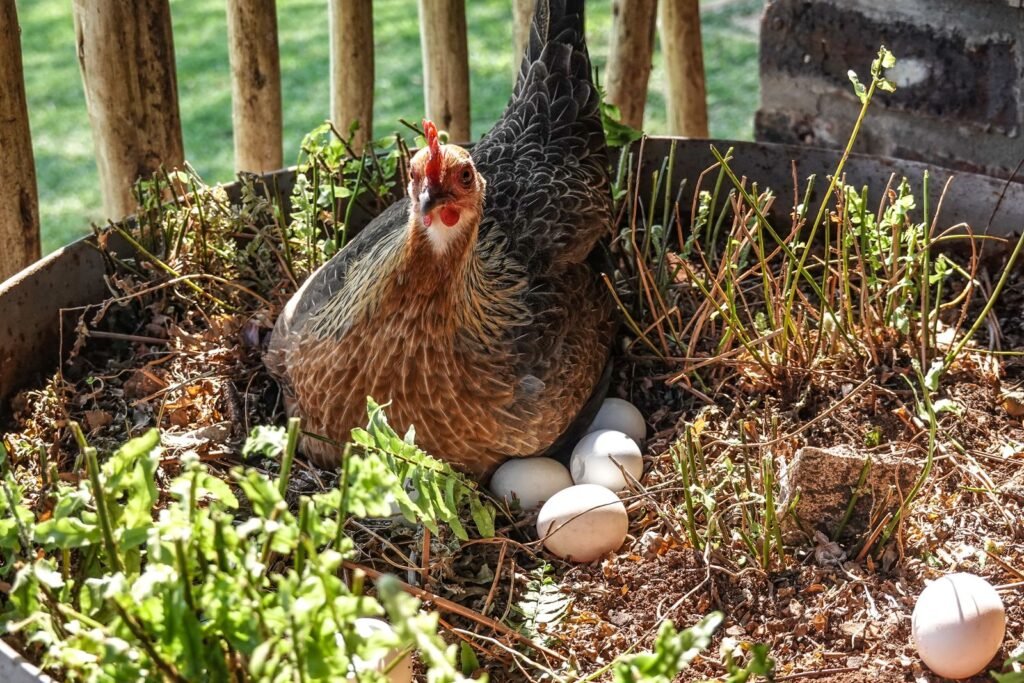
A broody hen sits on the nest, fluffs up, growls when disturbed and stops laying. Desi and Kadaknath hens are often broody. If you do not want chicks, collect eggs daily and gently move her off the nest, or place her in a separate wire-floored pen for a few days to break the brood.
5. Poor feed
This is the most common fixable cause.
- Laying hens need a balanced layer feed with enough protein (usually around 16 to 18 percent) and calcium
- Too many grains, kitchen scraps or bread dilute the diet
- Provide shell grit or limestone grit free-choice for strong eggshells
- Store feed dry and fresh; mouldy feed harms birds
How much feed and calcium does a layer need?
A laying hen of a commercial strain eats roughly 100 to 120 g of layer feed a day; improved backyard breeds eat a little less, and desi hens on free range may need only a supplement of 40 to 60 g. Each egg shell takes about 2 g of calcium, which is why layer feed contains far more calcium than grower feed.
- Switch from grower to layer feed at about 18 weeks or when the first eggs appear, not earlier, as excess calcium can damage young birds’ kidneys.
- Offer coarse limestone grit or crushed shell in a separate feeder; hens take more in the afternoon, when shells are being formed.
- Do not feed layer mash to growing chicks or roosters for long periods.
- Kitchen scraps and grain should be no more than a small part of the diet.
6. Not enough water
An egg is mostly water. Even a few hours without water, especially in summer, can stop laying for days. Provide clean water at all times in enough drinkers.
7. Heat stress
Above about 32 degrees Celsius (90°F), hens eat less and lay fewer, thinner-shelled eggs. Give shade, airflow and cool water. See our heat stress guide.
8. Stress and disturbance
Predators at night, dogs, loud noise, rough handling, moving birds, adding new birds and overcrowding all reduce laying. Keep a calm routine and secure housing.
9. Parasites
Mites, lice and worms drain hens' energy. Check under the wings and around the vent for lice and mites, especially at night, and treat as your vet advises. Read about worms in chickens.
10. Disease
A sudden drop in eggs across the flock, especially with soft-shelled, misshapen or rough eggs, can signal diseases such as Ranikhet, infectious bronchitis or egg drop syndrome. Check that vaccines are up to date and contact your vet if birds look unwell.
Diseases that cause an egg drop
| Disease | Typical egg signs | Other clues |
|---|---|---|
| Infectious bronchitis | Wrinkled or misshapen shells, watery whites | Mild breathing signs; young pullets infected early may never lay well |
| Egg drop syndrome (EDS-76) | Soft-shelled and shell-less eggs, pale shells | Birds otherwise look healthy; prevented by vaccination before lay |
| Ranikhet (Newcastle disease) | Sudden drop, shell-less eggs | Green diarrhoea, breathing signs, twisted necks, deaths |
| Bird flu | Sharp fall in eggs with very high deaths | Blue, swollen comb and wattles; notifiable, report immediately |
| Mycoplasma (chronic respiratory disease) | Gradual drop, poor shell quality | Rattling breathing, swollen face, foamy eyes |
| Fowl cholera | Drop with sudden deaths in adult birds | Swollen wattles, green droppings |
If more than a few birds are sick or dying, keep them isolated and ask a vet for a post-mortem and lab tests before treating blindly. Antibiotics do not fix viral egg drops.
Are they laying somewhere else?
Free-range hens may hide nests in bushes, haystacks or corners. Watch where your hens go in the morning, and provide clean, dark, comfortable nest boxes with straw (about one box for every 4 to 5 hens). Snakes, rats and crows also steal eggs.
Hens eating their own eggs
Egg-eating usually starts with a broken egg. Collect eggs often, provide enough calcium for strong shells, keep nest boxes dark and padded, and reduce crowding and boredom.
🩺 Dr. Vaishnavi’s Clinical Picks (Available on Amazon India)
An incubator lets broody hens get back to laying.
Hatch chicks while your desi hens keep laying
As an Amazon Associate, I earn from qualifying purchases. This costs you nothing extra.
Dr. Vaishnavi’s advice: When a flock stops laying, I first ask how fast it happened. A slow drop usually means light, feed or age; a sudden drop with strange eggs means disease. Keep a simple daily egg record and you will spot problems within days and save money on unnecessary medicines.
Frequently asked questions
How many eggs should a desi hen lay?
Desi hens commonly lay about 60 to 100 eggs a year. Improved backyard breeds and commercial layers lay many more with good feed and care.
Do hens need a rooster to lay eggs?
No. Hens lay eggs without a rooster. A rooster is only needed for fertile eggs to hatch chicks.
Can I give calcium tablets to my hens?
Provide shell grit or limestone grit and a proper layer feed instead. Ask your vet before giving any supplement or medicine.
My hens stopped laying after vaccination. Is that normal?
A short dip can happen with stress from handling. If laying does not recover within a week or two, or birds look sick, contact your vet.
Recommended reading
- Dr. Vaishnavi’s animal-care books are available on her Amazon author page.
- See all titles on the Books page.
Related Articles
References
- National Research Council. Nutrient Requirements of Poultry, 9th rev. ed. Washington, DC: National Academies Press; 1994.
- FAO. Small-scale poultry production. FAO Animal Production and Health Manual No. 1. Rome; 2004.
- ICAR-Directorate of Poultry Research, Hyderabad. Rural poultry varieties and package of practices.
More on Poultry
Homemade Desi Poultry Feed Formula in India (100 kg Ration)
Cut poultry feed expenses by 30%! Use this vet-balanced low cost desi poultry feed formulation at home in India with maize, soy…
CRD in Chickens: Winter Breathing Sounds, Treatment, and Curtains
Hearing ghur-ghur sounds in your flock? Learn poultry respiratory disease CRD and sound problem treatment in winter, ammonia control & antibiotic protocols.