 Written and reviewed by Dr. Vaishnavi Karmawat, B.V.Sc. & A.H., Registered Veterinary Practitioner
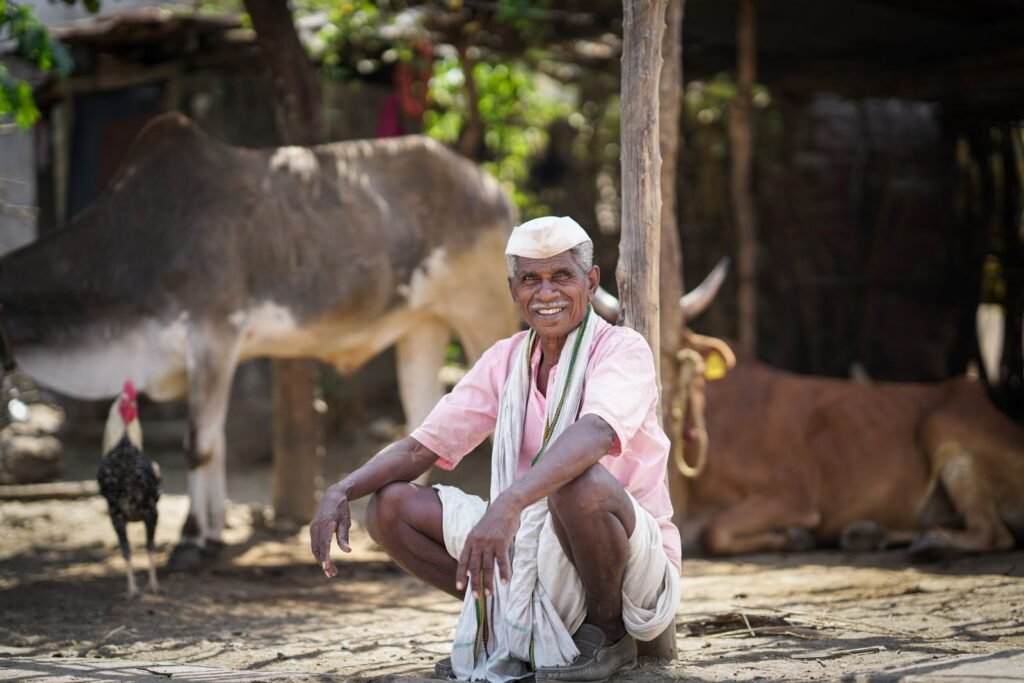
Feed, fodder, medicines and labour cost money every month, long before milk or animal sales bring it back. The Kisan Credit Card (KCC) for Animal Husbandry and Fisheries gives dairy, goat, sheep, pig and poultry farmers a revolving short-term loan for these costs, at an effective interest rate as low as 4% per year. Many farmers do not know they can get it even without owning agricultural land.
In this article
What the KCC for animal husbandry covers
A revolving cash credit for feed, fodder and vet care: you can withdraw and repay as needed within your limit. It covers:
- Concentrate feed, green and dry fodder, mineral mixture
- Veterinary treatment, vaccines and medicines
- Labour, electricity and water charges
- Insurance premium and small running costs
It is meant for working capital, not for buying animals or building sheds (those need a term loan or schemes like NLM).
Interest rate: how 4% works
| Component | Rate |
|---|---|
| Bank interest on KCC (up to ₹3 lakh) | 7% per year |
| Interest subvention from Government of India | 2% |
| Prompt Repayment Incentive (PRI) | 3% (if you repay on time) |
| Effective annual interest rate | 4% per year |
The 2% interest subvention + 3% Prompt Repayment Incentive (PRI) applies to the combined KCC limit up to ₹3 lakh (crop plus animal husbandry). Repay within the due date, usually 12 months, to get the full benefit.
How your limit is calculated: Scale of Finance (SoF)
Your credit limit is not random. It is based on the Scale of Finance (SoF) per animal set by the District Level Technical Committee (DLTC), which fixes how much it costs to maintain one animal for a year in your district.
| Animal unit | Typical yearly Scale of Finance (varies by district) |
|---|---|
| 1 crossbred cow | About ₹25,000 to ₹40,000 |
| 1 buffalo | About ₹30,000 to ₹45,000 |
| 1 desi cow | About ₹15,000 to ₹25,000 |
| 1 goat or sheep | About ₹2,500 to ₹5,000 |
| 100 poultry birds (layers) | About ₹20,000 to ₹40,000 |
Example: a farmer with 4 buffaloes in a district where SoF is ₹35,000 per buffalo can get a limit of about 4 x ₹35,000 = ₹1.4 lakh, plus a small margin for contingencies. Ask your bank branch for your district’s current SoF.
Collateral-free limit
Loans up to the collateral-free limit of ₹1.60 lakh to ₹2.00 lakh (the RBI limit was raised to ₹2 lakh in 2025) do not need land or property as security; only hypothecation of the animals. That is why landless dairy and goat farmers can apply. Above this limit, banks may ask for collateral or a guarantor.
Who is eligible
- Individual farmers, tenant farmers, sharecroppers and landless livestock owners who own or rear animals
- Self-help groups and joint liability groups
- You do not need agricultural land ownership for a KCC limit up to the collateral-free threshold
Documents checklist before you visit the bank
- Aadhaar card and PAN card
- Passport-size photos
- Bank passbook
- 12-digit Bharat Pashudhan ear-tag numbers for each animal (registered under NDLM, the National Digital Livestock Mission); this is now required by most banks
- Proof of animal ownership (purchase receipt, vet certificate, or panchayat or dairy society certificate)
- Milk society membership or milk payment slips, if a dairy farmer
- Land documents only if available (not mandatory below the collateral-free limit)
- Filled KCC application form
How to apply
- Through your bank: visit any public sector, regional rural or cooperative bank branch, or private banks offering animal husbandry KCC (such as the Bank of Baroda BAHFKCC, the Baroda Animal Husbandry and Fisheries Kisan Credit Card).
- Online via JanSamarth: go to the JanSamarth portal, choose Agri loans, Kisan Credit Card (Pashupalan KCC scheme / animal husbandry), check eligibility, fill in details and choose your bank.
- District-level weekly KCC camps: many states run camps through the animal husbandry department, banks and dairy societies. Ask your veterinary hospital or dairy cooperative.
The bank should process a complete application within about 2 weeks.
🩺 Dr. Vaishnavi’s Clinical Picks (Available on Amazon India)
Helpful resources and equipment while you plan and set up your farm.
Practical guide for planning and running a dairy farm
Goat farming basics in Hindi
As an Amazon Associate, I earn from qualifying purchases. This costs you nothing extra.
Frequently asked questions
Can I get KCC for 2 cows?
Yes. There is no minimum number; the limit depends on the number of animals and your district’s Scale of Finance.
Do I need land for KCC animal husbandry?
Not for loans up to the collateral-free limit.
What is the interest rate of KCC for dairy?
7% from the bank, reduced to an effective 4% with government subvention and prompt repayment.
Is ear tagging compulsory for KCC?
Most banks now ask for the 12-digit Bharat Pashudhan ear-tag number of each animal. Contact your veterinary hospital to tag and register animals for free.
Need help with livestock records for your KCC? Contact Dr. Vaishnavi Karmawat.
Related Articles
- Mangla Pashu Bima Yojana: Free Livestock Insurance in Rajasthan
- AHIDF Scheme: 3% Interest Subvention for Dairy and Feed Plants
- Is the NABARD Dairy Subsidy (DEDS) Still Available?
- Dairy Farm Bank Loan in India: Step-by-Step Guide and Documents
- Dairy Farm Loans and Subsidies in India: Gokul Mission and AHIDF
References
- Reserve Bank of India. Master Direction: Kisan Credit Card (KCC) Scheme.
- Department of Animal Husbandry and Dairying, Government of India. Kisan Credit Card for animal husbandry and fisheries farmers.
- NABARD. Kisan Credit Card scheme.
More on Government Schemes
NLM Poultry Farming Subsidy: ₹25 Lakh for a 1,000-Bird Parent Unit
Planning a hatchery? Check the NLM poultry farming subsidy 25 lakh eligibility and project report for a 1,000-bird parent farm & mother…
AHIDF Scheme: 3% Interest Subvention for Dairy and Feed Plants
Scaling your dairy business? Learn how the AHIDF scheme gives 3% interest subvention and a credit guarantee for dairy processing and cattle…