 Written and reviewed by Dr. Vaishnavi Karmawat, B.V.Sc. & A.H., Registered Veterinary Practitioner
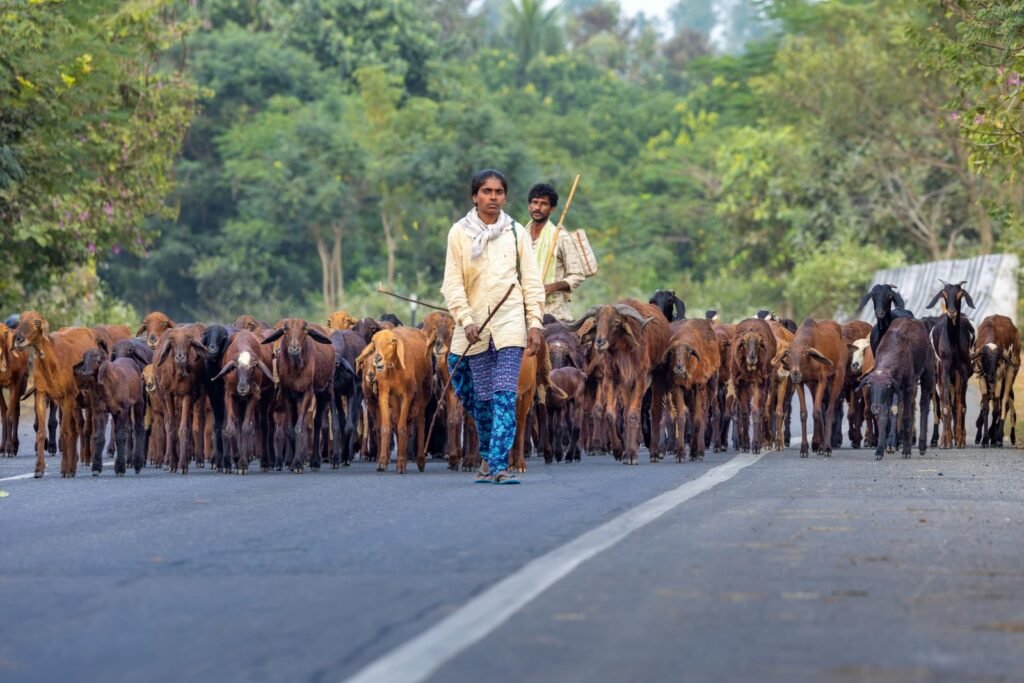
The National Livestock Mission Entrepreneurship Development Programme (NLM-EDP) offers a 50% back-ended capital subsidy up to ₹50 lakh to set up commercial goat and sheep breeding farms. It is one of the most valuable schemes for rural entrepreneurs, but many applicants misunderstand how it works and get stuck. This guide explains the real process, unit sizes, and the bank rules.
In this article
- The biggest misconception: it is not a free grant upfront
- Eligible goat and sheep unit sizes and subsidy caps
- Other activities under the NLM entrepreneurship scheme
- Who can apply
- Documents you need
- Step-by-step: how to apply online on nlm.udyamimitra.in
- Making your DPR strong
- A vet’s health plan for your goat farm
- Related guides
- Livestock insurance under NLM
- Frequently asked questions
- Related Articles
- References
Key Takeaways
- NLM gives a 50% back-ended capital subsidy (up to ₹50 lakh for goat and sheep farms) released through SIDBI into your loan account in two instalments.
- You need a bank loan sanction or bank-certified self-financing first; the subsidy is not an upfront grant.
- Other NLM activities include poultry, piggery, fodder and silage units, fodder seed processing, and since 2024, horse, donkey, mule and camel farms.
- NLM also subsidises livestock insurance: the farmer pays only 15% of the premium, for up to 10 cattle units per household.
- Most failed goat projects fail on animal health and fodder, not paperwork, so build a veterinary plan into the DPR.
The biggest misconception: it is not a free grant upfront
The 50% subsidy is back-ended. That means:
- You must first get your project financed by a bank loan sanctioned by a scheduled bank, or prove self-financing that is screened and certified by a scheduled bank.
- Only after the bank sanctions (and releases) the loan does the subsidy process move ahead.
- The subsidy is released through SIDBI directly to your loan account, in 2 installments: the first after the bank releases its first loan installment, and the second after the project is completed and verified by the State Implementing Agency (SIA).
You need to arrange the full project cost first (loan plus your margin money). The subsidy then reduces your loan.
Eligible goat and sheep unit sizes and subsidy caps
| Unit size (does or ewes + bucks or rams) | Maximum subsidy (50%) |
|---|---|
| 100 + 5 | Up to ₹10 lakh |
| 200 + 10 | Up to ₹20 lakh |
| 300 + 15 | Up to ₹30 lakh |
| 400 + 20 | Up to ₹40 lakh |
| 500 + 25 | Up to ₹50 lakh |
The subsidy covers capital cost such as sheds, equipment and purchase of animals, as per the approved project.
Other activities under the NLM entrepreneurship scheme
| Activity | Maximum capital subsidy (50% of project cost, capped) |
|---|---|
| Sheep and goat breeding farm (100+5 to 500+25 animals) | ₹10 lakh to ₹50 lakh depending on unit size |
| Rural poultry parent farm with hatchery (1,000 parent birds) | Up to ₹25 lakh |
| Piggery breeding farm (up to 100 sows and 10 boars) | Up to ₹30 lakh |
| Fodder: hay, silage, TMR or fodder block units | Up to ₹50 lakh |
| Fodder seed processing and storage | Up to ₹50 lakh |
| Horse, donkey, mule and camel breeding (added in 2024) | Up to ₹50 lakh |
The NLM guidelines were approved for 2021-22 to 2025-26. Check the portal for the current year’s status and any revised caps before preparing your report.
Who can apply
- Individuals, farmer producer organisations (FPOs), self-help groups, joint liability groups, farmer cooperatives, and Section 8 companies
- The applicant needs land ownership or a registered lease deed for the project land
- Training or experience in goat farming (a certificate from a KVK, RSETI or veterinary university helps)
Documents you need
- Aadhaar, PAN, bank statements, and photographs
- Land documents (ownership or registered lease deed)
- A Detailed Project Report (DPR) prepared as per NLM norms
- Training or experience certificate
- Quotations for animals and equipment
- Caste certificate if applicable, and GST registration where relevant
Step-by-step: how to apply online on nlm.udyamimitra.in
- Go to the nlm.udyamimitra.in portal and register with your mobile number and email.
- Choose the scheme: NLM, Entrepreneurship, Sheep and Goat.
- Fill in your details, select the unit size, and upload the DPR and documents.
- Submit. The application goes to the State Implementing Agency (SIA) of your state (usually the Animal Husbandry Department or Livestock Development Board).
- The SIA reviews and forwards eligible applications to the bank you selected.
- The bank appraises your project and visits your site. A bank loan sanction letter is mandatory for the subsidy.
- Once the loan is sanctioned and the first installment released, the SIA recommends the first subsidy installment, which SIDBI releases to your loan account.
- After the farm is complete and verified, the second installment is released.
Making your DPR strong
Your DPR should follow the KVASU / NLM operational guidelines and include:
- Breed choice and source (for example Sirohi, Jamunapari, Barbari, Osmanabadi or local breeds)
- Shed design, floor space and costing
- Green fodder land: about 1 acre per 25 to 30 goats
- Realistic kidding rates, mortality (5 to 10% kids) and sale prices
- Vaccination and deworming plan (PPR, ET, FMD, HS, goat pox), linked to a veterinarian
- Year-wise cash flow and loan repayment schedule
A vet’s health plan for your goat farm
Banks and the State Implementing Agency look for a credible health plan. More importantly, it decides whether the farm survives its first year.
Before the animals arrive
- Buy from known breeders or government farms, not weekly markets, where diseases such as PPR and goat pox spread easily.
- Ask for vaccination and deworming records, and have a vet examine every animal for body condition, udder, teeth, feet and signs of disease.
- Keep new animals in a separate quarantine shed for about 3 weeks before mixing them with the herd.
Vaccination calendar (typical, confirm locally)
| Disease | First dose | Repeat |
|---|---|---|
| PPR (goat plague) | Kids at about 3 to 4 months | Every 3 years as per vaccine, or per state campaign |
| Enterotoxaemia (ET) | About 3 to 4 months, booster after 3 to 4 weeks | Every 6 months, before monsoon and winter |
| Foot-and-mouth disease (FMD) | About 4 months | Every 6 months (free under NADCP) |
| Goat pox | About 3 to 5 months | Yearly |
| Haemorrhagic septicaemia | Before monsoon, as advised | Yearly in endemic areas |
Deworming and kid care
- Deworm on the basis of faecal egg counts and the FAMACHA eye-colour check rather than blindly every month; this slows dewormer resistance.
- Kids must get colostrum within the first hour of birth; aim for about 10% of body weight in the first 24 hours.
- Target kid mortality below 10%. Most early deaths come from cold, poor colostrum, pneumonia and diarrhoea.
- Keep the shed floor raised or dry, with good ventilation and no draughts.
- Maintain records of every birth, weight, treatment, sale and death; banks may ask for them, and they help you find problems early.
Related guides
- Our goat vaccination and deworming schedule chart helps your DPR’s health plan.
- Our Azolla cultivation guide shows how to cut feed costs in the project.
Livestock insurance under NLM
The 2024 changes simplified the risk management and insurance component of NLM:
- The farmer’s share of the premium is 15% for all categories and areas; the Centre and State pay the rest.
- Up to 10 cattle units per household can be insured (1 cattle unit = 1 large animal or 10 sheep, goats, pigs or rabbits). For pigs and rabbits the limit stays at 5 cattle units.
- Annual premium rates are capped (about 4.5% of the animal’s value in normal areas), with multi-year policy options.
- The scheme is run through state animal husbandry departments; ask your veterinary hospital when the enrolment drive opens.
For an NLM goat project, insuring the breeding stock protects both your income and your loan.
🩺 Dr. Vaishnavi’s Clinical Picks (Available on Amazon India)
Helpful resources and equipment while you plan and set up your farm.
Goat farming basics in Hindi
Gives liquid dewormers and medicines by mouth without waste
As an Amazon Associate, I earn from qualifying purchases. This costs you nothing extra.
Dr. Vaishnavi’s advice: I tell every NLM applicant that the subsidy is the easy part; keeping the animals alive and productive is the real work. Buy breeding stock from reliable sources, quarantine new animals, follow a vaccination calendar, and keep records. A healthy herd is what repays the loan.
Frequently asked questions
Is NLM goat subsidy given without a bank loan?
Self-financing is allowed, but it must be screened and certified by a scheduled bank, and the subsidy is still back-ended.
How long does NLM subsidy release take?
It depends on the state and bank. The first installment usually follows soon after the bank releases the first loan installment.
What is the minimum unit for NLM goat farming subsidy?
100 does plus 5 bucks, with a subsidy of up to ₹10 lakh.
Can I apply for NLM subsidy on leased land?
Yes, with a registered lease deed covering the loan period.
Need a vet-certified DPR for your NLM goat project? Contact Dr. Vaishnavi Karmawat.
Related Articles
- AHIDF Scheme: 3% Interest Subvention for Dairy and Feed Plants
- Is the NABARD Dairy Subsidy (DEDS) Still Available?
- Livestock Death Compensation for Floods and Disasters in India
- Livestock Insurance Claim Rejected? Common Reasons and Fixes
References
- Department of Animal Husbandry and Dairying, Government of India. National Livestock Mission: operational guidelines 2021-22 to 2025-26.
- National Livestock Mission online portal: nlm.udyamimitra.in.
More on Government Schemes
NLM Poultry Farming Subsidy: ₹25 Lakh for a 1,000-Bird Parent Unit
Planning a hatchery? Check the NLM poultry farming subsidy 25 lakh eligibility and project report for a 1,000-bird parent farm & mother…
AHIDF Scheme: 3% Interest Subvention for Dairy and Feed Plants
Scaling your dairy business? Learn how the AHIDF scheme gives 3% interest subvention and a credit guarantee for dairy processing and cattle…